Solitary wave formation in the compressible Euler equations
Abstract
We study the behavior of perturbations in a compressible one-dimensional inviscid gas with an ambient state consisting of constant pressure and periodically-varying density. We show through asymptotic analysis that long-wavelength perturbations approximately obey a system of dispersive nonlinear wave equations. Computational experiments demonstrate that solutions of the 1D Euler equations agree well with this dispersive model, with solutions consisting mainly of solitary waves. Shock formation seems to be avoided for moderate-amplitude initial data, while shock formation occurs for larger initial data. We investigate the threshold for transition between these behaviors, validating a previously-proposed criterion based on further computational experiments. These results support the existence of large-time non-breaking solutions to the 1D compressible Euler equations, as hypothesized in previous works.
Abstract of the arXiv version, arXiv:2412.11086.
Code and data
Reproducibility repository: https://github.com/ketch/Euler_1D_homogenization_RR
Animations
Formation of solitary waves
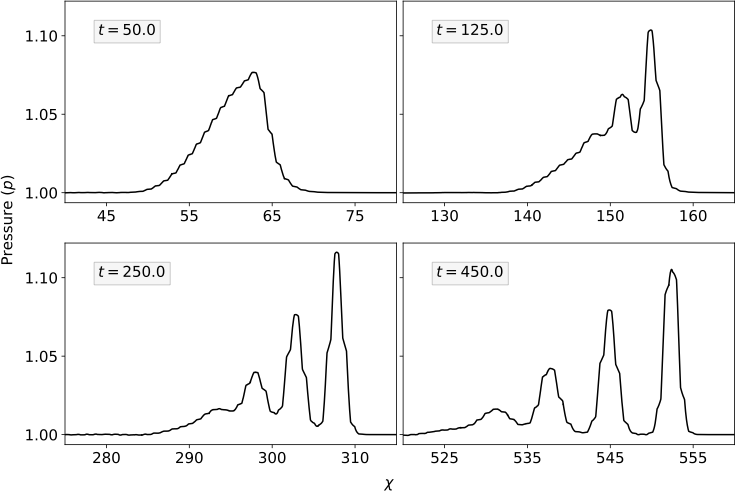
A pressure pulse in a gas whose density varies periodically in space breaks up into a train of solitary waves instead of forming shocks. The upper plot shows energy and the lower plot shows density; the plotting window moves along with the waves. This is the behavior described in Section 1.1 and shown in Figure 1, though the background density here varies smoothly rather than in piecewise-constant layers.
Comparison of the models
The setup of Section 2.5.1 and Figure 4: a moderate-amplitude pressure pulse, plotted in the material (Lagrangian) coordinate. The solutions of the Euler equations and the \(p\)-system are indistinguishable, and the homogenized \(p\)-system agrees closely, with differences in wave position growing slowly over time.
The same experiment, showing only the \(p\)-system and the homogenized \(p\)-system:
A larger pulse in a shorter, periodic domain, comparing the \(p\)-system and the homogenized \(p\)-system. The pulse splits into left- and right-going parts that wrap around the domain and meet again. The agreement is less close than for the smaller pulse above, and small-scale oscillations appear in the \(p\)-system solution.
Shock tube problems
These are the shock-tube-like problems of Section 4.1 (Figures 10 and 11): a smoothed step in pressure, from a higher value \(p_\ell\) on the left to 1 on the right, in a gas with periodically varying density. The measurements in the paper suggest that shocks form for \(p_\ell \ge 2\) and not, or only very weak ones, for smaller values.
With \(p_\ell = 1.8\):
With \(p_\ell = 2.8\):